
If you live in the Dallas-Fort Worth metroplex, you already know that hail season feels less like a season and more like an ongoing reality. North Texas sits squarely within what meteorologists call Hail Alley, a region stretching from the Texas Panhandle to the Dakotas where atmospheric conditions create ideal environments for severe thunderstorms and large hail. In 2024 alone, Texas recorded 878 major hail events, maintaining its position as the state with the most hail activity in the nation.
For homeowners considering a roof replacement, one question comes up repeatedly: Are Class 4 impact resistant shingles worth the extra investment? The short answer is that for most North Texas homeowners, they are. The longer answer involves understanding what these shingles actually do, how much they cost, what insurance discounts you can expect, and how to calculate whether the investment makes financial sense for your specific situation.
What Are Class 4 Impact Resistant Shingles?
Class 4 impact resistant shingles represent the highest level of hail resistance available for shingle roofing materials. The classification comes from a standardized test developed by Underwriters Laboratories known as UL 2218, which has become the industry benchmark for evaluating how well roofing materials withstand impact.
The UL 2218 test works by dropping steel balls of varying sizes onto shingle samples from specific heights. The test simulates the kinetic energy that hailstones of different diameters would deliver at terminal velocity. For a shingle to earn a Class 4 rating, it must survive two impacts from a two-inch steel ball dropped from 20 feet without showing any cracks, tears, or ruptures on the back surface. This test replicates the force of large hailstones, the kind that regularly pounds North Texas during spring and early summer storms.
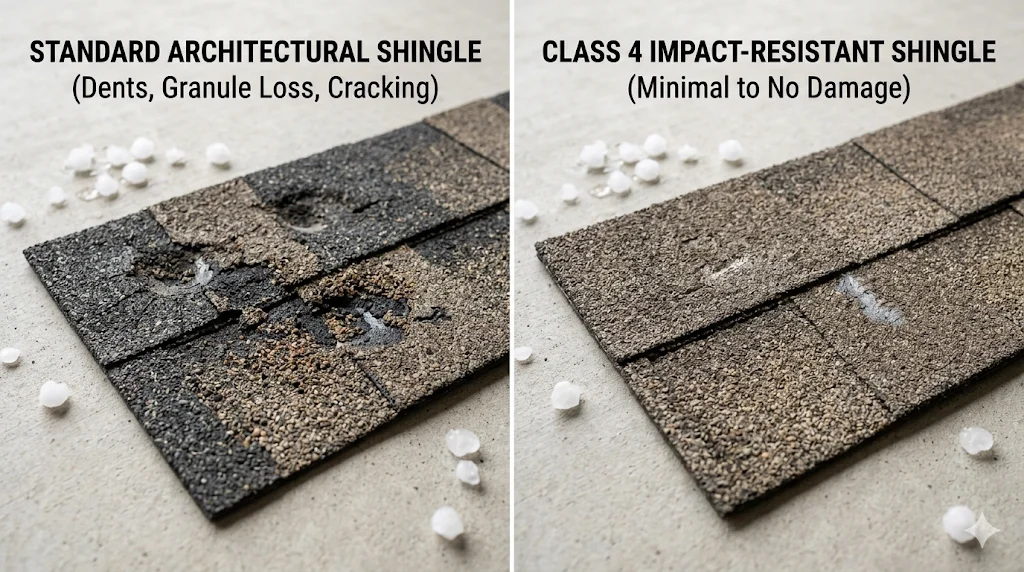
The four impact resistance classes correspond to progressively larger test balls: Class 1 uses a 1.25-inch ball from 12 feet, Class 2 uses a 1.5-inch ball from 15 feet, Class 3 uses a 1.75-inch ball from 17 feet, and Class 4 uses the 2-inch ball from 20 feet. Standard architectural shingles without impact ratings fail even the Class 1 test, which explains why they suffer so much damage during hailstorms that drop golf-ball or baseball-sized hail.
How Class 4 Shingles Achieve Impact Resistance
The secret behind Class 4 shingles lies in their modified asphalt formulation. Most impact resistant shingles use SBS polymer-modified asphalt, where SBS stands for styrene-butadiene-styrene. This polymer additive transforms the asphalt from a rigid material that cracks under impact into a flexible, rubber-like substance that absorbs and disperses impact energy.
Think of the difference between dropping a golf ball onto a ceramic tile versus dropping it onto a rubber mat. The tile shatters because it cannot flex or absorb the energy. The rubber mat deforms momentarily, absorbs the impact, and returns to its original shape. SBS-modified shingles work on the same principle. When hail strikes, the rubberized asphalt flexes rather than fracturing, then rebounds to its original form.
Beyond impact resistance, SBS modification provides several additional benefits. The polymer blend improves granule adhesion, meaning the protective surface layer stays intact longer even after repeated thermal cycling and weathering. SBS shingles also resist cracking in extreme cold and maintain flexibility across a wider temperature range than standard shingles. Some manufacturers report that SBS-modified shingles can even heal minor surface damage over time as the flexible asphalt naturally reforms.
Why North Texas Homeowners Face Unique Hail Risks
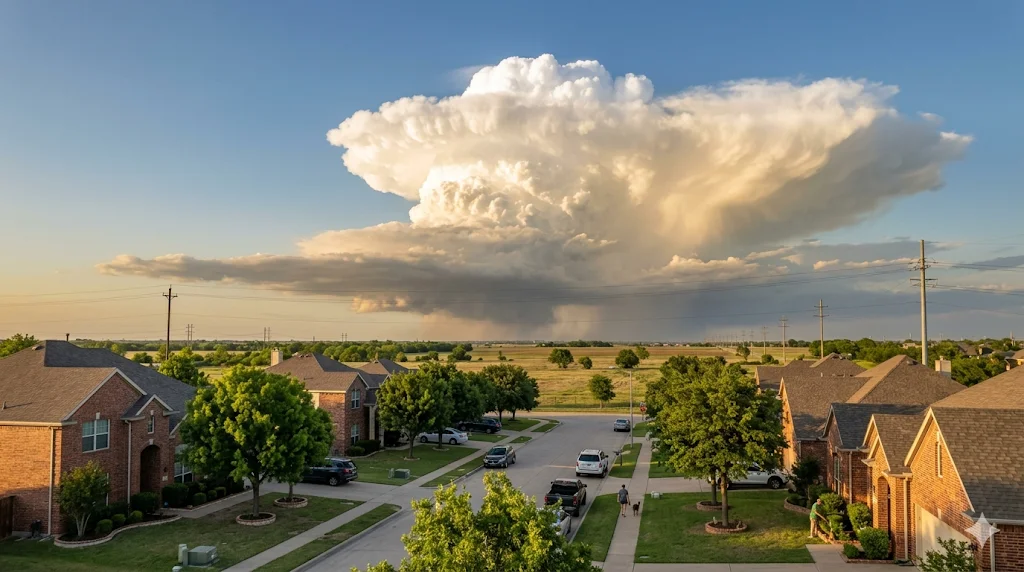
The numbers tell a stark story about hail exposure in North Texas. According to National Weather Service data, Tarrant County has experienced 126 days with severe hail since 2000, ranking among the highest in the state. Dallas County and Collin County show similar patterns. The metroplex regularly sees hail ranging from quarter-sized to softball-sized, with some storms dropping hailstones exceeding four inches in diameter.
May 2024 brought a particularly devastating example when golf-ball to softball-sized hail pounded areas across North and East Texas. That single storm system caused more than $2.3 billion in property damage and generated thousands of insurance claims. Events like this have become increasingly common, with Texas averaging more than $338 million in annual hail-related property damage.
The concentration of severe weather in this region is not coincidental. North Texas sits at the convergence of warm, moist air from the Gulf of Mexico and cold, dry air from the Rocky Mountains. When these air masses collide during spring and early summer, they create powerful updrafts capable of suspending hailstones aloft while they accumulate additional layers of ice. The result is the large, destructive hail that has made this region notorious among insurers and roofing contractors alike.
The Real Cost of Class 4 Shingles vs. Standard Shingles
Class 4 impact resistant shingles cost more than standard architectural shingles, but the premium is often smaller than homeowners expect. Current 2026 pricing in the Dallas-Fort Worth market shows Class 4 shingles running approximately $4.50 to $6.25 per square foot installed, compared to $4.00 to $5.25 per square foot for standard architectural shingles. For an average 2,000 square foot roof, this translates to an additional $1,000 to $4,000 depending on the specific product selected, roof complexity, and contractor pricing.
Several factors influence the actual cost difference for any specific roof installation. Roof pitch affects labor requirements, as steeper roofs require more time and safety equipment. Complex roof designs with multiple valleys, dormers, and penetrations increase installation time for any shingle type. The brand and specific product line matter as well, with premium options from manufacturers like GAF, Owens Corning, and CertainTeed commanding higher prices than entry-level Class 4 products.
Class 4 vs. Standard Shingles Comparison
| Feature | Class 4 Shingles | Standard Shingles |
|---|---|---|
| Impact Rating | UL 2218 Class 4 | None |
| Cost (DFW, Installed) | $4.50 to $6.25/sq ft | $4.00 to $5.25/sq ft |
| Realistic Lifespan (Texas) | 20 to 30 years | 15 to 20 years |
| Insurance Discount | 15% to 35% on dwelling | None |
| Hail Resistance | Withstands 2-inch hail | Vulnerable to most hail |
Insurance Discounts: The Financial Case for Class 4 Shingles
Texas was the first state to mandate that insurance companies offer discounts for impact-resistant roofing, implementing this requirement back in 1998. The Texas Department of Insurance recognized that reducing hail damage claims benefited both insurers and policyholders, creating a system where homeowners who invest in better roofing materials receive ongoing premium reductions.
Most Texas insurers offer discounts ranging from 15 to 35 percent on the dwelling coverage portion of homeowner policies for homes with Class 4 roofs. The exact discount varies by insurance company, policy type, and geographic location within the state. Areas with higher hail frequency generally qualify for larger discounts because the risk reduction is more significant. Some insurers also offer reduced or eliminated hail deductibles for Class 4 roofs, which can save thousands of dollars if a claim becomes necessary.
To claim your discount, your contractor must complete TDI Form PC068, the Impact-Resistant Roofing Installation Form. This document certifies that the installed shingles meet UL 2218 Class 4 standards and that the entire roof system, including hip and ridge caps, complies with requirements. Keep copies of this form along with product specifications and your contractor's certification, as your insurance company will need these documents to verify eligibility.
Calculating Your Return on Investment
The financial math on Class 4 shingles favors most North Texas homeowners, but running the numbers for your specific situation is important. Consider a typical scenario: You pay an additional $3,000 for Class 4 shingles on a roof replacement. Your insurance company offers a 25 percent discount on your dwelling coverage, which on a $4,000 annual premium translates to $1,000 in yearly savings. In this case, the upgrade pays for itself in three years, and every year thereafter represents pure savings.
The calculation becomes even more favorable when you factor in avoided roof repairs and the extended lifespan of Class 4 shingles. Standard architectural shingles in Texas typically last 15 to 20 years under normal conditions, but hail damage can cut that lifespan significantly shorter. Class 4 shingles commonly last 20 to 30 years in real-world Texas conditions, meaning you may avoid an entire roof replacement cycle over your homeownership period.
Contact your insurance agent before committing to a roof replacement to get exact discount figures for your policy. The TDI website maintains a database of average discounts by company, which can help you compare if your current insurer offers competitive rates. Some homeowners find that shopping for new insurance after installing a Class 4 roof yields even better savings than the discount their existing carrier provides.
When Class 4 Shingles Make the Most Sense
The strongest case for Class 4 shingles exists when several factors align. If you plan to stay in your home for five years or longer, you have enough time to recoup the additional cost through insurance savings. If your area experiences frequent hail, which includes virtually all of North Texas, the protection value is substantial. If your insurance company offers a meaningful discount of 20 percent or more, the return on investment accelerates significantly.
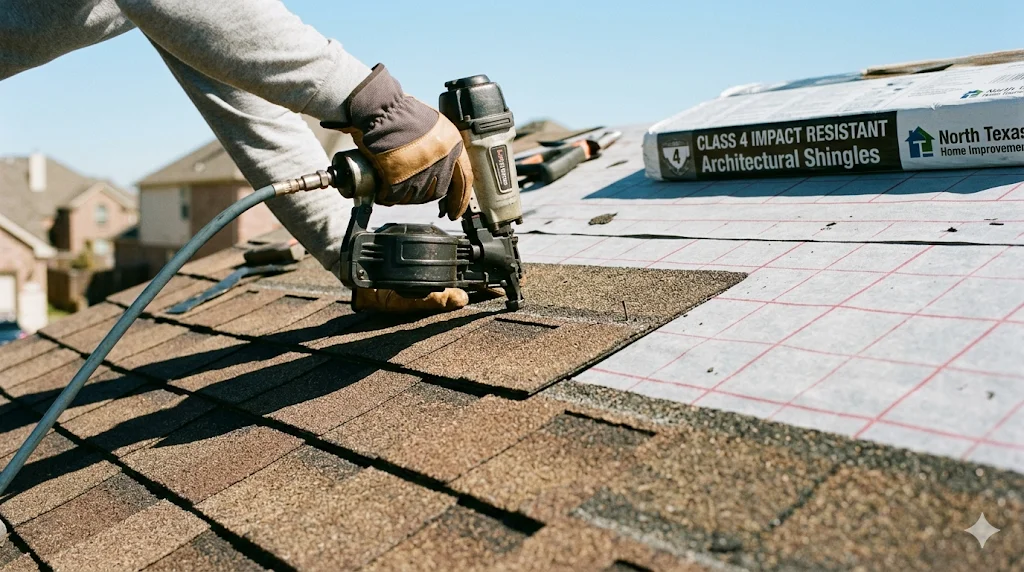
Homeowners who are already replacing their roof due to age or existing damage face an ideal opportunity to upgrade. The marginal cost of choosing Class 4 shingles during a planned replacement is much lower than undertaking a separate project later. A roof inspection can help determine whether your current roof is approaching the end of its useful life and whether now is the time to make the switch.
When Standard Shingles May Be Acceptable
Despite the advantages of Class 4 shingles, some situations make standard shingles a reasonable choice. If you plan to sell your home within two to three years, you may not have enough time to recover the additional investment through insurance savings. The resale value boost from Class 4 shingles, while real, may not fully offset the higher initial cost in a short ownership period.
Budget constraints can also influence the decision. If the choice is between affording a quality roof installation now versus waiting indefinitely for additional funds, a standard shingle roof installed correctly by a qualified contractor will still provide years of reliable service. Just understand that you accept higher hail risk and forgo insurance discounts with this choice.
Popular Class 4 Shingle Brands and Products
Several major manufacturers produce Class 4 shingles suitable for North Texas conditions. GAF offers the Timberline HDZ with ArmorShield technology, a popular choice that combines impact resistance with the familiar Timberline aesthetic. As a GAF certified Master Elite roofing contractor, we install these products with manufacturer backing and enhanced warranty coverage.
Owens Corning produces the Duration FLEX and Duration STORM lines, both featuring SBS-modified asphalt for Class 4 performance. CertainTeed offers the Landmark IR and NorthGate products with their proprietary polymer formulations. Malarkey Roofing Products has gained recognition for their NEX polymer technology used in the Vista and Legacy lines, which incorporates recycled rubber polymers for enhanced impact absorption.
When selecting a Class 4 product, verify that the packaging displays the UL 2218 Class 4 certification. Some products marketed as impact resistant may only meet lower class standards or may use different testing protocols. For full insurance discount eligibility, the shingles and the hip and ridge caps must both carry Class 4 certification.
Find Out If Class 4 Shingles Are Right for Your Home
The best way to determine whether Class 4 impact resistant shingles make sense for your situation is to get specific numbers for your roof and your insurance policy. Contact Pickle Roofing Solutions for a free roof inspection and estimate that includes both standard and Class 4 options. We can help you calculate your potential insurance savings and determine the true return on investment for your home. Call (972) 954-7186 or visit our contact page to schedule your consultation and take the first step toward a roof that protects your home and your budget.
Frequently Asked Questions
Do Class 4 shingles guarantee no hail damage?
No roofing product is hail-proof. Class 4 shingles are tested to withstand impacts from two-inch diameter hail, but larger hailstones can still cause damage. Extremely severe storms may produce cosmetic damage even on Class 4 roofs, though functional damage like cracks and leaks is far less likely than with standard shingles. The certification indicates superior resistance, not invincibility.
Will my insurance automatically give me a discount?
No. You must notify your insurance company and provide documentation proving your roof meets Class 4 standards. This includes the completed TDI Form PC068 from your contractor and product specifications showing UL 2218 Class 4 certification. Some insurers may require a post-installation inspection. Contact your agent before installation to understand their specific requirements.
Can I install Class 4 shingles myself to save money?
While technically possible, DIY installation creates several problems. Most insurance companies require licensed contractor installation to verify proper application and certify Class 4 compliance. Manufacturer warranties typically require professional installation by certified contractors. Improper installation can void both the warranty and your eligibility for insurance discounts, eliminating the primary financial benefits of choosing Class 4 materials.
How long do Class 4 shingles last compared to standard shingles?
In Texas conditions, Class 4 shingles typically last 20 to 30 years versus 15 to 20 years for standard architectural shingles. The SBS polymer modification that provides impact resistance also improves UV resistance and thermal cycling durability, extending overall lifespan. Manufacturer warranties often reach 40 to 50 years, though these are prorated warranties that reflect ideal conditions rather than realistic Texas performance.
Do hip and ridge caps also need to be Class 4?
Yes. Most insurance companies require the entire roof system to meet Class 4 standards for discount eligibility. This includes field shingles, hip caps, ridge caps, and often starter strips. Using standard hip and ridge components with Class 4 field shingles may disqualify you from insurance discounts and creates weak points where hail damage can still occur.
What documentation do I need for the insurance discount?
Keep copies of TDI Form PC068 signed by your contractor, product specifications or packaging showing UL 2218 Class 4 certification for all shingle components, your contractor's license and insurance information, and photos of product labels before installation. Your insurance company may request any or all of these documents. Processing typically takes two to eight weeks after submission.
About Pickle Roofing Solutions
Pickle Roofing Solutions is a GAF Master Elite certified roofing contractor serving homeowners throughout the Dallas-Fort Worth metroplex, including Allen, Plano, Frisco, McKinney, and surrounding communities. As a roofing contractor in Allen and roofing contractor in Plano, we specialize in impact-resistant roofing systems designed for North Texas weather conditions. Our team provides honest assessments, quality installations, and the documentation you need to maximize your insurance benefits.